

PROTECTION AGAINST GRID-SOURCED MALFUNCTIONS
Energy produced at power plants reaches buildings and facilities by passing through distribution and transmission lines. Since the transmission between the power plant, transformer, and building is carried out via electrical wires, it is impossible to completely prevent malfunctions. In fact, although studies on other alternatives are ongoing, there is currently no other way to transmit electricity to buildings and other structures under today’s conditions. Transmission via wires carries many risks, primarily grid-sourced problems.
Malfunctions Observed in Rainy Weather
Energy transmission is mostly provided through conductors. Electrical wires can be cited as examples of these conductors. Energy collected in transformers is transmitted to buildings through such equipment. The organization between conductors is facilitated by system components called insulators. The biggest cause of power outages seen in the rain is the damage to these system parts called insulators.
Outages and malfunctions experienced in rainy weather do not mean that the local electricity transmission system is of poor quality. Electric poles and wires are the weakest points of transmission, and it is inevitable for them to deform due to factors such as wind and rain. Not only electric poles but also transformers suffer damage in rainy weather.
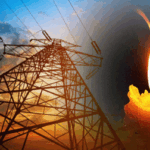
[Image showing high-voltage transmission lines during a storm with arcing or insulator failure]
On the other hand, the demand for consumption increases in such weather. As the need for light and heating grows, the energy in the grids intensifies, and the already vulnerable transmission lines fail, unable to handle this intensity. The reflection of this situation onto the installations of buildings will lead to problems much larger than a mere power outage.
Most electrical malfunctions result from the disruption of the current balance. When the imbalance in the transmission lines is reflected in buildings, it is likely that devices connected to the installation will malfunction, and installation components (such as cables, fuses, and electricity meters) will explode or catch fire.
In addition to all this, electric wires can snap in the event of strong winds. Furthermore, equipment in electrical transmission lines can also be damaged by the wind. Therefore, it is beneficial to take precautions against stormy weather.
Risks Arising from Grid Control
In 2015, a massive nationwide power outage occurred in Türkiye. The reason for this outage was the escalation of a malfunction observed in the transformers in Ankara/Gölbaşı. Since Türkiye’s electrical circulation is managed from this center, a malfunction that became uncontrollable led to a power outage lasting for hours.
The losses caused by this outage are expressed in billions. The main reason for this is that the surge created by the outage damaged devices. Moreover, surge arresters (parafudrs) and regulators were not sufficient to control this overvoltage that occurred in seconds.
As a result, grid-sourced outages and voltage changes can happen at any time. It is imperative to take precautions against these risks. It is possible to protect against such situations with Trimbox.
Grid-Sourced Problems Are Out of Warranty Scope
Precautions in transformers and transmission lines are not always sufficient. Electricity distribution companies may not be able to make adequate interventions in extreme situations, or even if they do, overvoltage may not be prevented. However, Trimbox ensures that energy is adjusted to reasonable levels and that systems continue to operate. With Trimbox, you can be completely protected from grid-sourced problems.
Simple precautions sometimes save lives. The best investment we can make for our family, our business, and our environment is protective measures. With Trimbox and GNDSeries, you can be protected from electricity-related damages and resulting electrical contact fires.
Whatsapp : +90 555 014 24 23